Heat Pipe Module Integration
Heatpipe Assembly 004
What is a heat pipe module heat sink?
A heat pipe module heat sink is a thermal management device that applies the heat pipe principle, generally consisting of a heat dissipation base plate, heat pipes, and fins welded together. It can solve heat dissipation challenges caused by limited space or concentrated heat sources, overcoming the contradiction between heat generation power and effective heat dissipation capacity that traditional cooling methods cannot address.
- Products
- Heat Sinks
- Process
- Heat Pipe Module Integration
- Additional Processes
- Extrusion / skived fin + CNC Machining
- Material
- Al1060、 Al 6061、Al6063、Cu1100、Cu1020
- Size / Color
- Customer Customization
- Surface Treatment
- Sandblasting, wire drawing, painting, anodizing, electroplating
- Quality Control
- Full inspection
- Applications
- Mechanical equipment, power supplies, electronic equipment
- OEM
- Accept
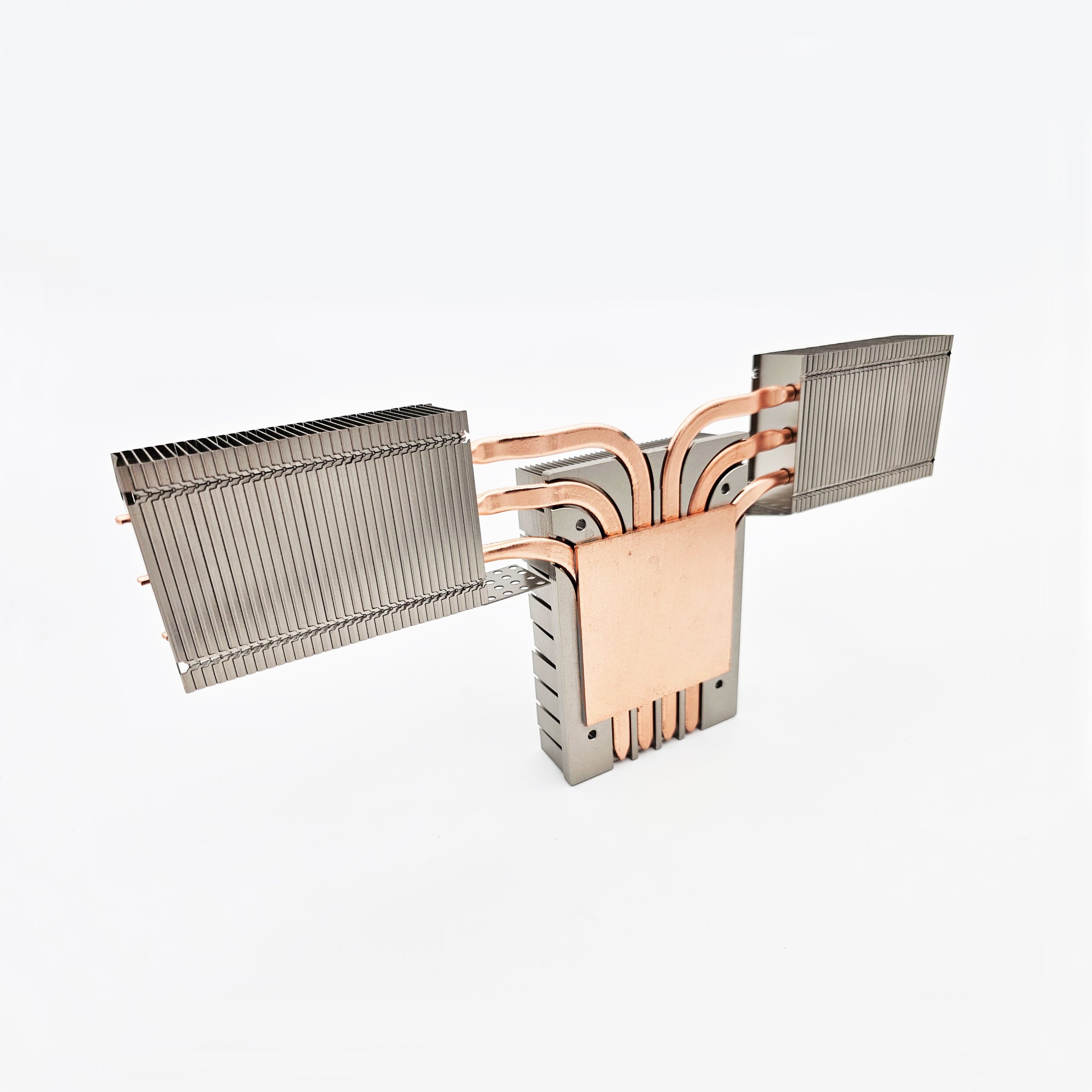
What is a heat pipe module heat sink?
A heat pipe module heat sink is a thermal management device that applies the heat pipe principle, generally consisting of a heat dissipation base plate, heat pipes, and fins welded together. It can solve heat dissipation challenges caused by limited space or concentrated heat sources, overcoming the contradiction between heat generation power and effective heat dissipation capacity that traditional cooling methods cannot address.
✓A heat pipe is a type of heat transfer element whose thermal efficiency can reach dozens of times that of metals. It consists of three main components: a sealed shell, a working fluid, and a capillary structure. The working fluid absorbs heat and vaporizes from the higher-temperature side, and the saturated gas condenses and releases heat on the lower-temperature side. The working fluid changes phase within the application temperature range, while the shell keeps the heat pipe working fluid in a vacuum seal, enabling continuous heat transfer for decades.
✓1、Excellent Thermal Conductivity: Strong thermal conductivity with relatively low thermal resistance, 100–1000 times that of a copper pipe of the same size. Heat transfer direction is reversible; either end can serve as the evaporation end or the condensation end.
✓2、Wide Applicability: Suitable for a broad temperature range, from low temperature -243°C to high temperature >1000°C. Even with a small temperature difference, it can transport large amounts of heat.
✓3、High Compatibility: Simple and compact structure, lightweight, small volume, and easy to maintain. Adopting heat pipe technology, satisfactory heat dissipation results can be achieved even without fans or with low-speed, low-airflow motors, making it suitable for high-power heat dissipation and low-noise scenarios. As heat pipe processing technology continues to improve, reliability, safety, and durability will further increase, while costs and prices will continue to decrease.
✓The thermal performance of heat pipes is indeed very powerful, but to better exert their effectiveness, precise matching with basic module components such as fins is still required.
✓1、Heat Pipe Selection: Heat pipes with different capillary structures have certain differences in heat transfer performance. In practical applications, forming processes such as bending and flattening are required to meet the heat dissipation needs of different heat sources. Additionally, the diameter, length, and assembly orientation of the heat pipe all affect its heat transfer performance.
✓2、Fin Manufacturing and Assembly: Typically matched with heat pipes, stamped or skived fin heat sinks are used. The thickness, length, spacing, and arrangement of the fins, the connection process between fins and heat pipes, through-fin and reflow soldering processes all affect the overall heat dissipation performance.
✓3、Module Welding: The base plate, heat pipes, and fins must ultimately be joined together through welding. The flatness of the base plate, the connection between fins and the base plate and heat pipes, and the welding of heat pipes to the base plate all introduce additional thermal resistance.
Heat Pipe Module Radiator Design Key Points
Cost-Effectiveness Considerations
1、Ideal choice for high-power heat dissipation requirements in limited-space, low-noise, and environmentally friendly scenarios.
2、Engineering decisions for the optimal heat dissipation solution generally depend on cost and performance. Heat pipe module radiators can be fabricated from heat pipes of different structures, fins of different processes, and base plates of different materials, then assembled and welded together; therefore, the cost range of a single heat dissipation module varies widely under different application scenarios and operating conditions.
3、Yongxin Hongtai Technology can provide professional and more cost-effective recommendations based on your specific application scenario and demand scale.
Contact Us:
+8615632275585
Professional 24/7 Service for You
- Current Product
- Heatpipe Assembly 004
- Product Series
- Heat Pipe Module Integration
- Category
- Heat Sinks
Product Showcase