Friction Stir Welding Process
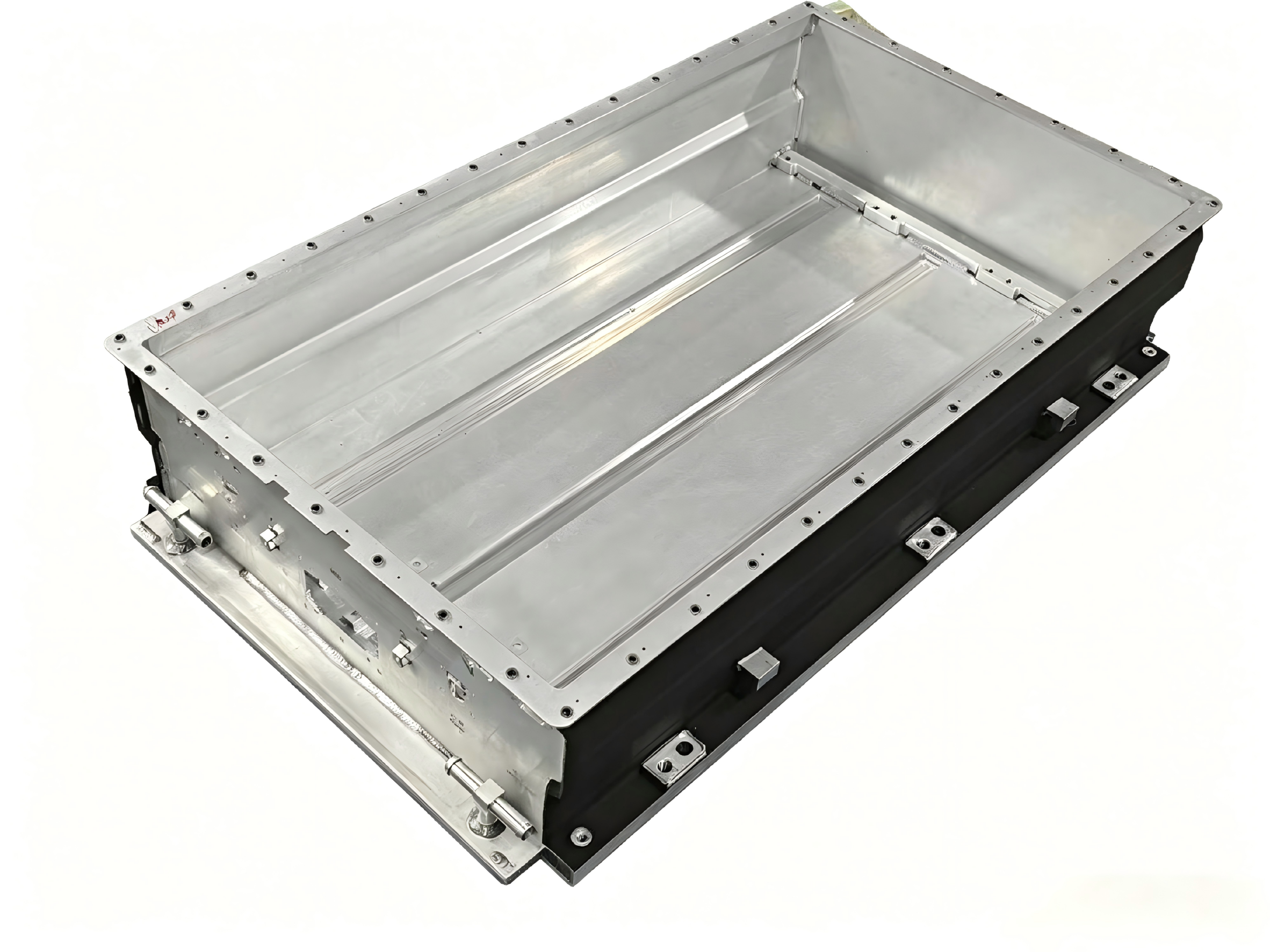
Battery Tray 002
What Is a Friction Stir Welding (FSW) Liquid Cold Plate?
Friction stir welding (FSW) technology is a solid-state joining process that can seal-connect water chambers formed by different processes with the outer cover. This method requires no solder or flux, and can ensure uniform and consistent weld depth and a dense forged weld joint throughout the entire weld, with good sealing, high weld strength, and properties close to the base material.
- Products
- Battery Tray
- Process
- Friction Stir Welding Process
- Additional Processes
- Friction stir welding + CNC machining
- Material
- Aluminum alloy profiles, plates
- Size / Color
- Customer Customization
- Surface Treatment
- Sandblasting, wire drawing, painting, anodizing, electroplating
- Quality Control
- Full inspection
- Applications
- Commercial & industrial energy storage (C&I), large-scale energy storage
- OEM
- Accept
What Is a Friction Stir Welding (FSW) Liquid Cold Plate?
Friction stir welding (FSW) technology is a solid-state joining process that can seal-connect water chambers formed by different processes with the outer cover. This method requires no solder or flux, and can ensure uniform and consistent weld depth and a dense forged weld joint throughout the entire weld, with good sealing, high weld strength, and properties close to the base material.
✓1、Profile + Friction Stir Welding (FSW)
✓Utilizes the extrusion process to directly form the cold plate flow channels, with circulation passages opened via machining. The liquid-cooled plate assembly is joined and sealed using the friction welding process. This type of cold plate surface is not suitable for too many screw holes.
✓2、Die Casting + Friction Stir Welding (FSW)
✓Die casting followed by welding offers good process control and stable production, with batch delivery capability. Process control of die casting impurities, porosity, and other issues is required. Whether using a conservative sealing ring approach or friction weld joining, process reliability must be improved to avoid leakage issues.
✓1. Excellent uniformity: Friction stir welded cold plates offer safer and more stable heat dissipation performance. Friction stir welded cold plates have larger flow channels, further reducing thermal resistance. They are particularly flexible in handling complex flow channels and channels with elevation differences.
✓2. High joint reliability: The weld contains no fusion weld porosity defects, no element burn-off, and no hot cracks. As a solid-state welding process, friction welding is a fundamentally defect-free joining method that ensures high reliability with no leakage.
✓3. High material strength: FSW is a solid-state joining process; since the entire material does not need to be heated, the base material does not soften. In addition, the material strength of the joint is equal to or higher than that of the parent material.
✓1. Flow channel design: Design the cold plate flow channel structure based on manufacturing processes, product operating conditions, thermal resistance distribution, and other factors, including cold plate size, flow channel structure, and inlet/outlet positions.
Friction Stir Welded (FSW) Cold Plate Design Key Points
Cost-Effectiveness Considerations
2. Flow channel design must meet the following friction stir welding process requirements:
Cover plate welding structure: There are three main welding structures—lap joint, counter-lap joint, and non-planar. The counter-lap joint is the conventional water-cold plate welding structure with the best welding effect. The cover plate lap step should be no less than 1 mm to avoid collapse during welding.
Cover plate machining allowance: Since surface milling is required after welding, the cover plate thickness should generally include CNC machining allowance. A typical cover plate thickness is 2–3 mm, with approximately 0.5 mm of allowance, which can withstand pressure within 1 MPa.
Weld edge allowance: The weld edge should include friction stir welding tool allowance. For a 3 mm cover plate, at least 5 mm of edge allowance is required to avoid edge weld collapse. It is best to communicate with the welding process provider beforehand.
1. Friction stir welding offers a simple welding process, high production efficiency, and is suitable for batch production.
2. No additional filler material is required during welding, making it economical and environmentally friendly.
3. Yongxin Hongtai Technology can provide professional and more cost-effective recommendations based on your specific application scenarios and demand scale.
Contact Us:
+8615632275585
Professional 24/7 Service for You
- Current Product
- Battery Tray 002
- Product Series
- Friction Stir Welding Process
- Category
- Battery Tray
Product Showcase